Thursday, December 14, 2006

When 'Buy What You Know' Doesn't Pay


As I penned my list of the Five Worst Managed Companies in the U.S. in October, I had several other companies in mind that were being considered for the article. However, upon closer inspection, these companies had a different theme that I would now like to discuss. Today's list of five inauspicious companies has one thing in common: They are companies with great products that are bad investments. As before, my list could be longer and you may have your own favorites. Also note, that these are bad investments but could be a decent trade from time to time. Without further ado, and in no particular order, here is Scott Rothbort's list of Companies With Great Products That Are Bad Investments:

1. TiVo (TIVO): The quintessential great product bad investment company. I told my wife six years ago that we had to buy a TiVo. She had no idea what a TiVo or DVR was at the time. Six years later, we can't live without it. In fact, we still have the original box and lifetime subscription that we originally purchased. You would think that TIVO had a great concept and would be printing money. No so. By far, TIVO is the best example of how to screw up the concept of giving away razors and making customers pay for the razor blade. Since going public and now for 31 consecutive quarters, TIVO has posted a loss. The most recent quarter was the same old story for TIVO: more losses; litigation issues; fiddling with subscription packages; and, delays in collaborative agreement. Buy a TiVo but not TIVO.

2. Six Flags (SIX): What can be more fun than a day with the family at the amusement park? Well maybe a day at the ballpark, but you get my point. You have to be a real misanthrope to hate amusement parks. Disney (DIS) knows how to build and manage an amusement park. SIX, on the other hand, has managed to deliver declining returns to shareholders. In fact, a weekly chart of SIX looks like a roller coaster ride: a big climb, a rapid fall, some ups and down and then return to terra firma. SIX has been under new management for several quarters now and, frankly, they have just continued the failures of their predecessors. As an example, they managed to bungle the Great Escape in the Lake George region. The geniuses at SIX repaved the Great Escape parking lot this year (it does look good), but in doing so initiated a $10 per car parking fee for the first time ever. There is a Yiddish terms to describe this decision: chutzpah (gall, audacity, nerve). So they spent lots of cash (heavily borrowed), charged to park, and attendance declined. Spend your hard-earned cash for a day at Six Flags but not for a single share of stock.

3. Vonage (VG): Get rid of land lines, give your local telephone company the Bronx cheer and use the Internet for telephone calls. Voice Over Internet Protocol (VoIP). Sounds great. Go ahead and use it. Many people are switching. We have not switched to VoIP but would consider it some day. My sister-in-law has gone VoIP. She is satisfied. I have heard pros and cons in the VoIP debate but nevertheless, I have to say, that as a product and technology it is a great concept. VG seemed to be promoting itself for years. I call it the longest road show ever. It was also the most bungled IPO since the Wilt Chamberlain debacle back in the 1990s. If you have or plan to use VoIP be careful and don't swap your old AT&T (T) stock for VG in the process.

4. Krispy Kreme Doughnuts (KKD): If you read Jim Cramer's Confessions of A Street Addict, then you would probably know Jim as someone who lived for a Krispy Kreme and a great stock idea. Unfortunately, KKD could only deliver the former and not the latter. Those delectable delights are irresistible. Even though the "Under New Management" sign is hanging in the Krispy Kreme window, you have to wonder whether the KKD business model is or ever was viable. Sales continue to decline. The baking business has always been tough. Dunkin Donuts has been handed from owner to owner for years with relatively little success. Just look at the history of Interstate Bakeries or Tasty Baking (TSTY). Bring a dozen Krispy Kremes to your next client meeting, but don't sell them on the stock. Nothing beats McDonald's (MCD) when it comes to a food service investment.

5. Alternative Energy Stocks: Let's reduce our dependence on fossil fuels and tell OPEC to stick it where the sun doesn't shine. It's like a bad gift: It's the thought that counts. This entire asset class gets the great product bad investment nod. We can use light, water, wind, steam or bovine excrement to generate energy for all I care. But even if Earth, Wind and Fire were to sing for us, it is highly unlikely that a stand-alone company is going to make you a dime in the alternative energy sector. Maybe some big-cap companies like Archer Daniels Midland (ADP) or a utility like FPL Group (FPL) can hide their alternative energy losses under the rest of their profitable portfolios. Occasionally, a Johnny-Come-Lately alternative energy stock will go IPO and get investors all lathered up in the first few months of life only to eventually succumb to traditional valuation techniques. The pink sheets and OTC bulletin boards are littered with the carcasses of alternative energy stocks.

Here is a Web site devoted to alternative energy stocks. Go ahead, knock yourself out, and try to find a stand-alone alternative energy investment. Over the long run, these are bad investments. In the meantime, think green, and invest in Exxon Mobil (XOM).

At the time of this Blog entry, Scott Rothbort, his family and or clients of LakeView Asset Management, LLC were long shares of McDonald's (MCD) and Exxon Mobil (XOM).

Monday, December 04, 2006

The Worst-Run Companies in the U.S.

The following article was originally published on The Street.com's Street Insight website (see links to the right) on October 18, 2006. In addition, I followed up with an interview on Street.com TV the following week (the link to the video also appears on the right).

As we are now deeply entrenched in the 2006 third-quarter earnings season, the question that always pops up in my mind when we are at this juncture is, what are the worst-run companies in the U.S.?

Without further ado, and in no particular order, here is my list:

  1. Industrials: Alcoa (AA) Year to year, quarter to quarter, this is The Gang that Couldn't Shoot Straight (by the way, also the name of a great book by Jimmy Breslin). When commodity prices work against it, it delivers disappointments. When commodity prices work in its favor, never fear! It will botch it up and disappoint. Competition is never a problem for Alcoa; it does a fairly good job of competing against itself.

  1. Technology: Lucent (LU)). How do you destroy Bell Laboratories, once the leading edge of telecommunications innovation in the world? Answer: Spin it off from AT&T (T)), load it up with debt, put lousy management in charge and lose the creative talent to the competition. At least it will soon be Alcatel's (ALA) problem. Au revoir.

  1. Media/entertainment: Cablevision (CVC). Or should I say Dolanvison? The Dolan family has managed to destroy shareholder value while increasing their own wealth for many years. In the process, they have destroyed a New York icon, the Knicks, mismanaged another, the Rangers, sabotaged an Olympic bid, delivered lousy service to customers, made a bad investment in The Wiz, failed to grab up the old Adelphia properties on the cheap, piled on debt and then tried to rip off shareholders in last year's failed privatization offer.

After a special cash payment of $10 to shareholders in April, the Dolans were finally able to grab CVC back from shareholders just this past month. Finally, shareholders will be rid of the Dolans and, if they are smart, will invest the proceeds of their sale into a better-managed company.

  1. Financial services: Janus Capital (JNS). We are in the middle of the biggest asset-management boom of all time, and this company has managed to move in reverse. Assets have flowed with the accompanying management fees to the competition, and this is likely to be a unidirectional movement. Don't be fooled by the recent stock performance.

  1. Retail: It's a tie. Too close to call. Sharper Image (SHRP) and Pier 1 Imports (PIR). I actually ran a five-year comparative chart of the two companies. The relative returns were as close as a pennant race between the Tampa Bay Devil Rays and the Kansas City Royals. Relatively competitive, but absolute losers.

Sharper Image reminds me of the Scotch Tape Store sketch from Saturday Night Live in the 1970s. All that the store sold was Scotch tape. All that Sharper Image seems to sell are ionic breeze air purifier machines. Have you ever gone to one of its stores? It's where the men hang out while the women spend money at the other retailers -- you know, those retailers who know how to manage a business.

As for Pier 1, that store has more junk in it than any women I know would be caught dead living in the same house with.

I am sure you have your own nominees, especially those that have cost you performance in the past. The lesson is, when you invest in a stock, you are also investing in management.


Note: Subsequent to the publication of the article above, Alcatel's acquisition of Lucent was completed. The new company is aptly named Alcatel Lucent (ALU).

Monday, November 27, 2006

2006 Holiday Shopping

On Friday, November 10, for the second straight year, I led a group of Stillman School of Business students from Seton Hall University (SHU) to the Palisades Center in West Nyack, NY for an intensive one day research project in which we surveyed and observed shoppers. The following Monday through Thursday we followed up the mall research with a nationwide survey focusing on shopping tends and preferences. Last week, SHU and LakeView Asset Management, LLC released some of our findings in the following press release:

_________________________________________________________________

HOLIDAY SHOPPING SEASON ANALYSIS IS IN!

Seton Hall University Students Forecast Holiday Shopping Trends,

in the NY Metro Area and Across the Country

Flat screen TVs are still hot, but satellite radio and Direct TV are not, and holiday season sales could be flat to somewhat higher compared to last year! These are just a few of the fascinating, fact-based predictions Seton Hall University’s Stillman School of Business students have to offer, based upon their second annual grass-roots, on-the-ground survey conducted November 10 at Palisades Center in West Nyack, New York, as well as their national telephone poll conducted November 13-16 at Seton Hall’s Polling Center.

Under the guidance of Scott Rothbort, M.B.A., professor of finance at Seton Hall and president of LakeView Asset Management, LLC, Seton Hall students interviewed over 700 respondents in total, asking a wide range of questions covering personal income, shopping preferences and plans. What are the answers?

  • Personal income was once again the most important factor determining how much shoppers will spend this year.
  • Overall, shoppers expect to spend about the same or just slightly more in the 2006 holiday season compared to the 2005 holiday season.
  • Given that personal income and employment are higher in 2006 relative to 2005, we are predicting that total 2006 holiday sales will rise in line or slightly greater than increases in US Gross Domestic Product over the same period of time.
  • Consumers prefer to stay down to earth when asked about satellite entertainment. Respondents who did not have satellite television such as Direct TV (DTV) or Dish Network (DISH) or satellite radios such as Sirius (SIRI) or XM (XMSR) overwhelmingly did NOT intend to purchase such technology.
  • Flat screen televisions are more likely to be purchased by current non-owners than any other technology in our survey.
  • When asked about fast food, respondents almost as often named Wendy’s (WEN) and McDonald’s (MCD) as their favorite fast food restaurant handily outranking rival quick service company Burger King (BKC). When it comes to pizza, nothing satisfies as much as the local pizza parlor.
  • Google is definitely the dominant internet search engine.
  • In a subject that has emerged from local grass roots efforts, we asked mall shoppers at the Palisades Center in West Nyack NY if aluminum bats should be banned in favor of wood bats. It appears that there is no decisive opinion either yes, no or not sure. However, while those agreeing to the ban were fairly evenly split between men and women, those opposed to it were almost 2 to 1 male to female, while the undecided were 1.5 to 1 female to male. This could be an issue which gets solved over the kitchen table at homes across our metropolitan area.
__________________________________________________________________________________

In addition, today, I was interviewed on TheStreet.com TV by Gregg Greenberg. We discussed our research and my thoughts on Black Friday.

At the time of this Blog entry, Scott Rothbort, his family and or clients of LakeView Asset Management, LLC were long shares of McDonald's (MCD).

Sunday, November 12, 2006

Where's Mortimer and Randolph Duke?

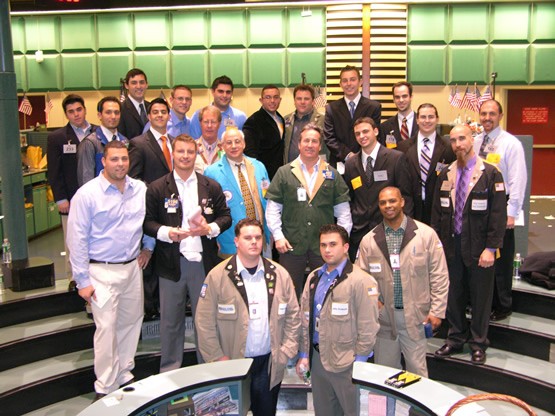
On Monday November 6, 2006 I led a group of Stillman School of Business students on a visit to the New York Board of Trade (NYBOT). While at the exchange, the students participated in a simulated commodity futures trading session. That's me wearing my old Merrill Lynch (MER) bluish/green trading floor jacket given to me by my MER floor broker friends from the Chicago Board Options Exchange (CBOE)

The event was part of the "NYBOT Ringside Goes Schoolside" program where universities in the tri-state area are invited to the exchange. The NYBOT was founded in 1870 and was known as the New York Cotton Exchange (NYCE). It provides the world's premiere futures and options markets for several internationally traded agricultural commodities including cocoa, coffee, cotton, frozen concentrated orange juice (FCOJ) and sugar.

Remember FCOJ from the Eddie Murphy / Dan Aykroyd movie Trading Places? That movie was filmed at the exchange's old site in the World Trade Center.

At the time of this Blog entry, Scott Rothbort, his family and or clients of LakeView Asset Management, LLC were long shares and/or call options of Merrill Lynch (MER).

Friday, November 03, 2006

How To Invest By Brown Bagging It To The Game


Last Sunday I went to Giants Stadium for the New York Giants / Tampa Bay Buccaneers football game, also dubbed the Barber Bowl. Accompanying me were my wife, our oldest son and some cousins. As usual we brought along some sandwiches and soda in the car and eat them on the way to the game. Having not been to Giants Stadium since last season it was not until we passed the concession stand did I once again get stadium sticker shock. So, on my trusty Palm (symbol: PALM) Treo 650 I snapped a picture of the concession stand (which is posted above). For what you can save by eating before the game by bringing your own food, drink and snack you can buy one share of Aramark Corporation (symbol: RMK), the company that runs the concessions. So the next time you go to a game, bag your own lunch and call your broker the next morning.